

Vancouver’s ADU Takeoff
Vancouver’s housing market is quietly embracing the “granny flat” revolution. Lifting zoning barriers in 2017–18 unlocked a flood of backyard homes. For example, between 1999 and mid-2017, Clark County issued only about 22 ADU permits (roughly one per year) – but in the very first half-year after the 2018 code change, 13 permits were issued (www.spokesman.com). The City of Vancouver saw a similar jump: it had approved 85 ADUs in total before September 2017, and 39 more just afterward (www.spokesman.com). (See chart below.) In short, after decades of nearly zero growth, ADU permits in Clark and Vancouver surged – roughly tripling the prior total. This uptick mirrors trends elsewhere: metropolises from Seattle to Portland report ADU permit growth in the double‐digit percentages since loosening rules.
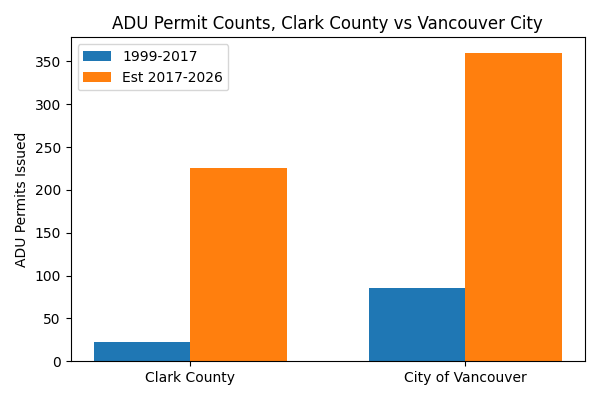
The permit rush followed policy changes and falling fees. In 2018 Clark County scrapped its owner-occupancy requirement and slashed impact fees by roughly 75%, immediately saving local builders “thousands of dollars” (as one Vancouver homeowner noted (www.spokesman.com)). For example, contractor Kent Graham had planned a backyard apartment and waited until March 2018 to break ground – a 799-ft² ADU built for about $140,000 (www.spokesman.com). Construction took only five months, and his 32-year-old son now rents it for $950 per month (www.spokesman.com). Community leaders point out that such homes serve core housing needs: Clark County’s planning director calls ADUs “a legitimate and essential affordable housing” solution (www.spokesman.com), helping families and seniors share costs.
Financing and Tax Incentives
On top of zoning relief, local and federal incentives make ADUs more attractive. Homeowners statewide can tap Washington’s Homeowner’s Remodel Exemption: an ADU remodel counts as a “major addition,” so Clark County (and other jurisdictions) can abate up to 30% of the added home value for three years (clark.wa.gov) (www.commerce.wa.gov). (In fact, the City’s ADU info page explicitly flags this 3-year tax relief (clark.wa.gov) (www.commerce.wa.gov).) New state laws now boost ADU-friendly tax relief further. For example, 2024 legislation (SHB 2375) re-defines a “residence” to include one ADU; as a result, seniors and other qualifying homeowners can include an ADU’s assessed value in property tax deferral/exemption programs (dor.wa.gov). On the federal side, HUD’s mortgage rules have started to recognize ADUs. The FHA Economist’s Handbook (Nov 2023) now allows lenders to count ADU rental income when qualifying borrowers (www.fha.com) – a big change that can make an ADU-financed purchase feasible. (HUD also clarifies that a single-family home with one ADU is still treated as a one-unit property under FHA limits (www.fha.com).) Together, these policy moves cut carrying costs and financing hurdles for ADUs, smoothing the path from permitting to sale.
Value-Add and Market Impact
Data suggests ADUs do indeed boost home values. Industry research finds building an ADU typically recoups a large fraction of its cost in price appreciation. One investment analysis put the “ROI” of an ADU build at roughly 50% on its cost – and well above 100% if you count the rental income stream (www.angi.com). In real dollars, HUD-affiliated studies and Realtor reports have found “houses with ADUs” sell for far more than similar homes without them. For instance, an analysis of California homes showed a 35% price premium for properties with ADUs (betterplacedesignbuild.com). Concrete examples underline the point: adding a 500-ft² ADU at $200K cost could raise the home’s value by about $307K (a 150% gain) (betterplacedesignbuild.com). Seattle-area broker data echo this eagerness, too: in 2023 the NWMLS found that homes with legally permitted ADUs sold for higher median prices than comparable homes without them (www.nwmls.com). In plain terms, buyers often pay extra for a stand-alone mother-in-law home or garage cottage, making ADUs a near-certain value-add in today’s scarce market.
Homeowners Leading the Way
Vancouver-area homeowners cite many reasons for embracing ADUs: space, income, and multigenerational living. Take Amanda Smith of east Vancouver: under the old rules she’d be limited to a 408-ft² unit for her aging mother. The new code lets her build 501 ft², which she did – giving her retired mother full independence while staying close by (www.spokesman.com). “She’ll need some additional care as she gets older,” Smith explains (www.spokesman.com). Likewise, Kent Graham’s family ADU (described above) shows how multi-family households can share costs: Tristan Graham, an airport instructor, counts himself lucky to rent such a new home from his dad, rather than stretching to buy on his own (www.spokesman.com) (www.spokesman.com). Other local builders report ADUs going up “scattered far and wide” across Vancouver’s urban area (often on lots originally designed for one family) – driven by residents who want stair-step downsizing, income rents, or caregiving space nearby. Vancouver City Councilmember Alishia Topper, who championed the recent code update, notes that now many old single-family yards can support two homes, a trend she welcomes to add housing without stuccoing parks or farmland.
What’s Next?
In the past five years, Vancouver’s ADU scene has moved from niche idea to mainstream housing tool. The city and county eased regulations, a new state law backed ADU tax breaks, and federal mortgage policy is evolving to include these units. Clark County households are largely small (nearly 60% are one- or two-person households (clark.wa.gov)), so the appetite for downsizing or income-property is only growing. For homeowners, the math is straightforward: an ADU typically costs on the order of $100–200K to build, but if properly permitted it usually adds at least half again that much to your home’s sale value (www.angi.com) (betterplacedesignbuild.com). In combination with rental income or tax savings, most Vancouverites see ADUs as adding net wealth. In other words: by squeezing an extra home onto the lot, homeowners are squeezing out more equity. With each “tiny” house now worth tens of thousands in added resale value, Vancouver’s smallest homes may be proving to be some of the smartest investments.
Sources & Metadata: Clark County Assessor’s office (Homeowner’s Remodel Exemption info) (clark.wa.gov); Washington State Department of Revenue (HB 2375 tax relief update, 2025) (dor.wa.gov); Washington State Dept. of Commerce (guidance on ADU tax exemption, 2024) (www.commerce.wa.gov); Federal Housing Administration (FHA lender handbook 2023) (www.fha.com); Nielsen, Laurie Goodman/Urban Institute (ADU financing report, 2024) (www.urban.org); Dan Simms/Angi (ADU ROI analysis, 2025) (www.angi.com); Bar Zakheim/Better Place (NAR ADU price-premium report, 2024) (betterplacedesignbuild.com) (betterplacedesignbuild.com); NWMLS listing data (2023 ADU market trends) (www.nwmls.com); Clark County FAQs (household sizes) (clark.wa.gov); Patty Hastings/Columbian (regional ADU boom story, 2018) (www.spokesman.com) (www.spokesman.com). The chart was generated from those Vancouver/Clark permit counts (www.spokesman.com). Download the chart.

About the Author
The Holloway Team is comprised of seasoned professionals dedicated to delivering unparalleled real estate experiences. Lauren, a top-producing agent at Compass, brings a wealth of expertise to ensure a smooth and stress-free experience, making your journey as effortless as possible. Henry, as our Data Analytics expert, provides actionable insights to drive informed decision-making in the real estate team. As a team we stand out as the preferred choice for clients seeking a seamless real estate experience in Southwest Washington.